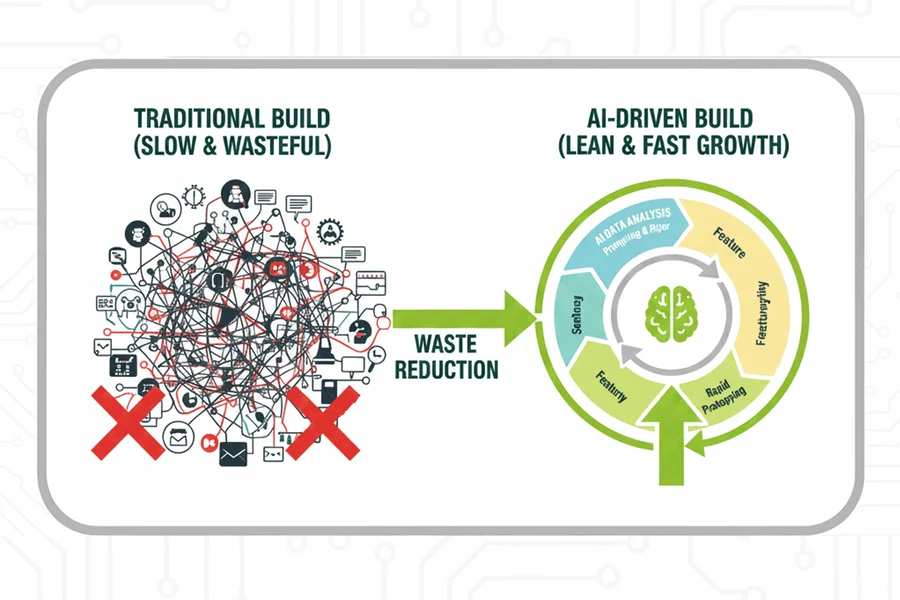
For the solopreneur and early-stage founder operating within the constraints of the Lean Startup methodology, the only metric that matters is validated learning. Every minute spent on non-core activities—drafting boilerplate code, debugging simple syntax errors, or manually writing documentation—is waste. The traditional path from a vague idea to a usable Minimum Viable Product (MVP) is choked with these time sinks.
This comprehensive guide focuses exclusively on how to inject Generative AI into the BUILD phase, detailing how to leverage structured workflows to accelerate design, streamline requirements gathering, and rapidly generate high-quality, foundational code—all geared toward getting a testable product into a customer's hands faster.
Ideation to Artifact: Generating Context for Validation Speed
The greatest risk in the Lean Build phase is building the wrong thing. The founder's pressure to rush means bypassing critical planning, which leads to slow, expensive pivots later. AI solves this by serving as your virtual Product Manager and Architect, generating the essential artifacts you need to define the right scope for your MVP.
Scope and Clarity: The AI-Driven Project Charter (The Strategic Filter)
The Project Charter is your crucial tool for defining the initial hypothesis and its scope. You must ensure your MVP is minimal enough to launch quickly but viable enough to test the core value proposition. The Charter acts as a strategic filter, ensuring you only build features that directly contribute to the core learning goal.
The Charter Prompt Structure (Focus on Constraints):
"Act as a professional Project Manager for a lean startup focused on minimizing waste. Based on the concept:
[Insert 2-sentence product idea here, e.g., 'A simple, fast URL shortener with basic analytics for small business owners']
, draft a Project Charter. The charter must rigidly define 1. Core Problem/Hypothesis (what is the single biggest assumption we are testing?), 2. MVP Scope (3 features max—list what is explicitly out of scope to prevent feature creep), 3. Key Performance Indicators (KPIs) for first-user interaction success (e.g., Conversion Rate > 10%), and 4. Exit Criteria (predefined metrics for when we pivot or persevere?)."
Automated Architecture Sketching: Avoiding Over-Engineering
As a founder who "vibes code," there is a constant temptation to use the latest, most complex technology. Over-engineering is fatal to a Lean startup. Use AI to recommend the simplest, most cost-effective stack.
Architecture Prompt Example (Focus on Scalability and Cost):
"Based on the following features:
[List 3 MVP features]
, suggest a minimal, cost-optimized, and scalable serverless architecture suitable for a cloud-native deployment (AWS or Firebase). Detail the primary components (e.g., Database, Frontend, Authentication) and sketch the high-level data flow. Emphasize component choices that minimize initial operational cost. Avoid solutions that require dedicated server maintenance."
Precision for Testing: User Stories & Acceptance Criteria
In a Lean context, User Stories are not merely documentation; they are the blueprint for your future measurement system. Every story must lead to a testable outcome. AI excels at translating abstract concepts into the standard Gherkin-style format (Given/When/Then) used for acceptance criteria.
User Story Prompt Example (Focus on Testability):
"Expand the following feature idea into five detailed User Stories, complete with clear Acceptance Criteria for each: 'Users need to be able to reset their forgotten password.' The application is a React front-end communicating with a Node.js API. The criteria must focus on observable user behavior and system state changes, suitable for automated testing."
Example AI Output:
-
User Story 1 (The Happy Path): "As a user, I want to request a password reset, so that I can regain access to my account."
- Acceptance Criteria: GIVEN I am on the login page, WHEN I click 'Forgot Password' and enter a valid email, THEN I see a success message and an email is sent with a unique token link.
The resulting documentation—the Charter, the Stories, and the Architecture—becomes the precise context you feed back into the LLM for all subsequent code generation tasks, ensuring alignment, consistency, and minimal architectural friction when it's time to pivot or grow.
Prompt-Driven Code Generation: Mastering the Multi-Step Sequence for Risk Reduction
The largest risk in solo development is introducing errors or security flaws in boilerplate code that then requires time-consuming rework. Achieving high-quality, production-ready artifacts requires mastering multi-step prompt sequences—treating the AI as a domain expert that you guide with constraints.
The principle is simple: Context over Code. Your job is not to write code; your job is to perfectly articulate the context (the schema, the framework, the constraints, the style guide, the security requirements). The AI handles the syntax, boilerplate, and implementation details, dramatically reducing the probability of human error in mundane tasks.
Case Study Deep Dive: The Three Pillars of Automation
This multi-step approach is mandatory for success in the high-risk, high-reward areas of development.
| Artifact Goal | Lean Benefit | Key Context Requirement |
|---|---|---|
| Unit Test Generation | Reduces Rework: Prevents immediate bugs from entering the codebase. | Function Signature, Language/Framework, Naming Convention (e.g., AAA Pattern) |
| Text-to-SQL Query | Avoids Friction: Prevents SQL injection vulnerabilities and performance bottlenecks. | Schema Definition (Tables/Columns), Target SQL Dialect (Postgres, MySQL) |
| CI/CD Pipeline | Accelerates Deployment: Standardizes launch process, making pivots faster. | Target Platform (GitHub Actions, Azure DevOps), Language/App Stack |
Generating Robust Unit Tests for Fast Feedback
Why Multi-Step? The Lean Approach to AI-Driven Development
In a Lean environment, the core principle is rapid feedback to minimize waste. The faster you identify a flaw or misunderstanding, the less time is wasted on building the wrong thing. Relying on a single, monolithic AI prompt often fails to capture the complexity and edge cases of real-world development. The multi-step prompting strategy is the Lean Founder's answer to this challenge, turning the AI into a structured, proactive development partner.
Generating Robust CI/CD Pipelines (The Automated Launch Button)
For the solo founder, every deployment must be instant and repeatable. Infrastructure-as-Code is mandatory, but writing it is tedious. AI can instantly scaffold the necessary YAML, but it needs a detailed mandate to ensure security and robustness.
The process of using AI for this scaffolding involves a clear, three-step prompt sequence.
AI-Augmented API Design (Clarity over Complexity)
APIs must be clear for external users and future developers. Use AI to generate standardized documentation that minimizes integration friction for your first users.
/api/v1/user/create (POST) and /api/v1/links/{id} (GET). Define the input and output JSON schema for both."Generating a standard specification like this upfront forces rigor in the design and dramatically accelerates onboarding for any early-adopter technical users. The clarity of your Application Programming Interfaces (APIs) is paramount, not just for external users, but for the maintainability of your product by future developers. By leveraging AI to generate standardized, high-quality documentation, you can significantly reduce the integration friction experienced by your very first users—a critical factor in early adoption.
The process of using AI to generate this documentation begins with clearly defining your core API structure. You must specify the primary endpoints for your Minimum Viable Product (MVP), such as a /api/v1/user/create endpoint for creating a user (a POST request) and a /api/v1/links/{id} endpoint for retrieving a link (a GET request). Crucially, you must also define the complete input and output JSON schemas for each of these endpoints.
Once these schemas are defined, the next step is to instruct the AI to generate a complete OpenAPI (Swagger) specification document, typically in YAML format. This specification must be rigorous, detailing all necessary response codes, including successful responses (200) and common error states (400, 401, 500). Generating this standard specification upfront forces a necessary rigor in your API design, which dramatically accelerates the onboarding process for any technical early adopters, turning documentation from a passive reference into a powerful enablement tool.
Building the AI Development Toolkit: Operational Leverage for Solopreneurs
AI's deepest value is in standardization and automation. It eliminates the cognitive load of remembering every detail, allowing the founder to focus on customer development.
Standardization via AI SOPs (Standard Operating Procedures)
You are the entire engineering and product team. Consistency is the only way to avoid chaos and future debt. AI can generate the internal policies you need to maintain that consistency—your company's first rulebook.
SOP Generator Prompt Example (Cost Avoidance):
Draft a standardized four-step Code Review checklist suitable for a GitHub Pull Request template. The checklist should enforce 1. Functional correctness, 2. Performance consideration (N+1 query check, index check), 3. Error Handling conformity (standardized JSON response), and 4. Naming convention adherence. Explain why each step is critical for a lean, single-founder operation, focusing on minimizing future maintenance time.Bulk Content Generation for Lean Development
Software requires massive amounts of non-core content—test data, config files, mock responses. AI handles this bulk content generation instantly, freeing up your time for customer interviews.
- Generating Synthetic Test Data (Privacy First): Instead of manually writing 100 entries for your database, prompt the AI: "Generate 50 realistic, synthetic customer records for a US-based e-commerce site. Ensure the data includes unique emails, plausible names, purchase dates (last 6 months), and randomly generated, high-entropy API keys. CRITICAL: Data must be completely non-PII."
- Error Message Catalogues: Standardized error messages drastically improve the user experience and simplify debugging. Prompt the AI: "Generate a catalog of 10 standardized, user-friendly error messages (e.g., ERR-AUTH-001: Invalid Credentials) for the authentication service. Include the technical description and the user-facing message for each."
- Configuration Templates: Stop copying old files. Use AI to generate environment-specific configuration templates (e.g., staging.yml, production.yml) with placeholder values, ensuring all required variables are present and secure.
Automating the Mundane (Zero Waste Task Automation)
The Lean founder must eliminate "grunt work." Repetitive tasks like cleaning up logs or writing complex regular expressions are immediate targets for AI automation.
Scripting Prompt Example (Efficiency Gain):
Write a Python script using the re library that analyzes a log file (access.log). The script must extract and count the occurrences of all HTTP 4xx and 5xx error codes and output the top 5 most common request paths associated with them. The output must be formatted as a simple CSV.Building Reusable AI Tools (Prompt Stacks)
The ultimate form of delegation is creating a reusable, pre-tested prompt sequence—a Prompt Stack. This is your personal software factory for generating reliable artifacts.
Prompt Stack Example: The Unit Test Generator Stack
Conclusion: The Solo Unicorn's Lean Mindset
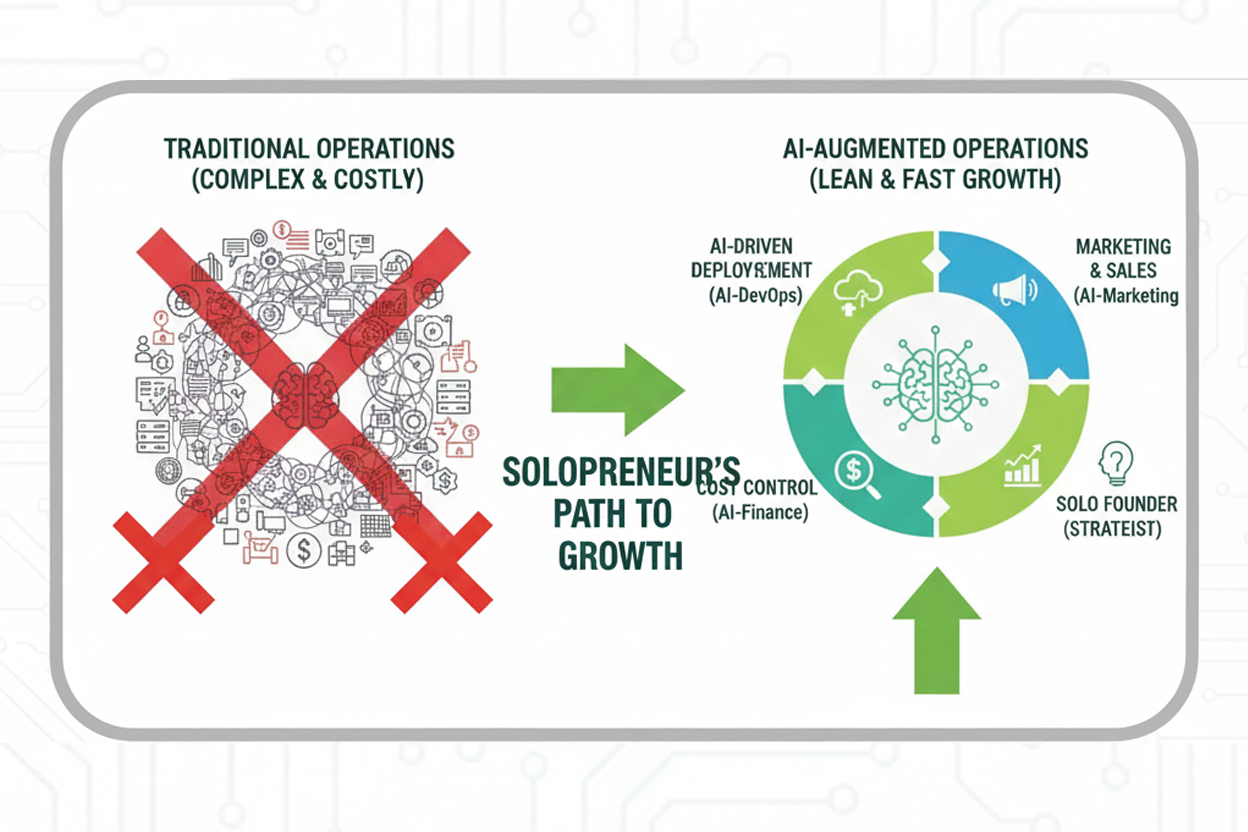
The AI-Augmented Software Development model is the only way for a solopreneur to adhere strictly to Lean principles while maintaining technical excellence.
It is the transition from thinking, "How do I write all this code and documentation?" to the only sustainable founder question: "How do I structure the perfect context and commands to quickly generate and validate only the minimum artifacts required for my next learning cycle?"
By delegating foundational work (planning, documentation, scaffolding) and leveraging multi-step prompting for quality assurance, the solopreneur can cut their MVP development time by 30-50%. This transforms weeks of high-risk grinding into days of strategic, de-risked refinement—the only way to truly scale without staff and succeed in the ruthless Lean market.
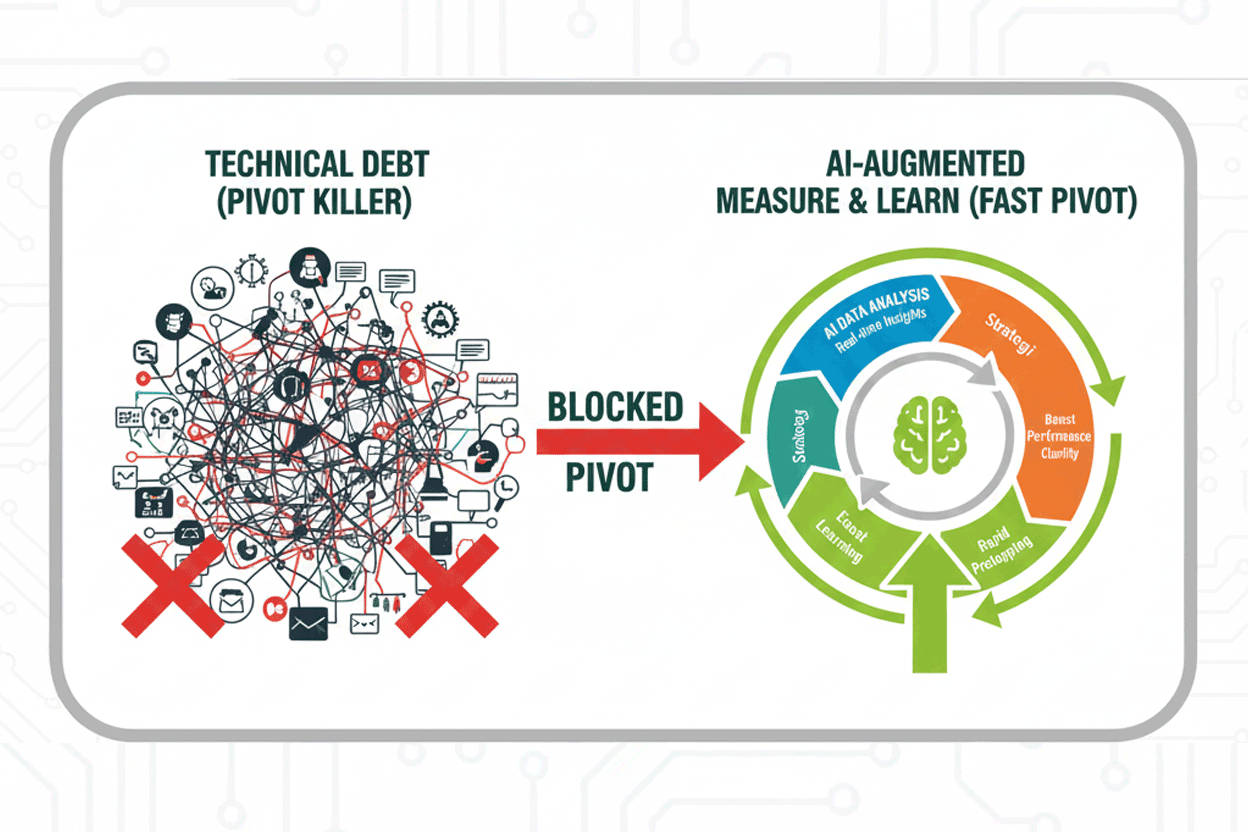
Next up: You've built fast, but is it secure and fast? We'll dive into the MEASURE & VALIDATE phase, focusing on automated quality assurance and proactive technical debt mitigation—your primary tools for surviving the early stages.

No comments yet
Be the first to share your thoughts on this article!